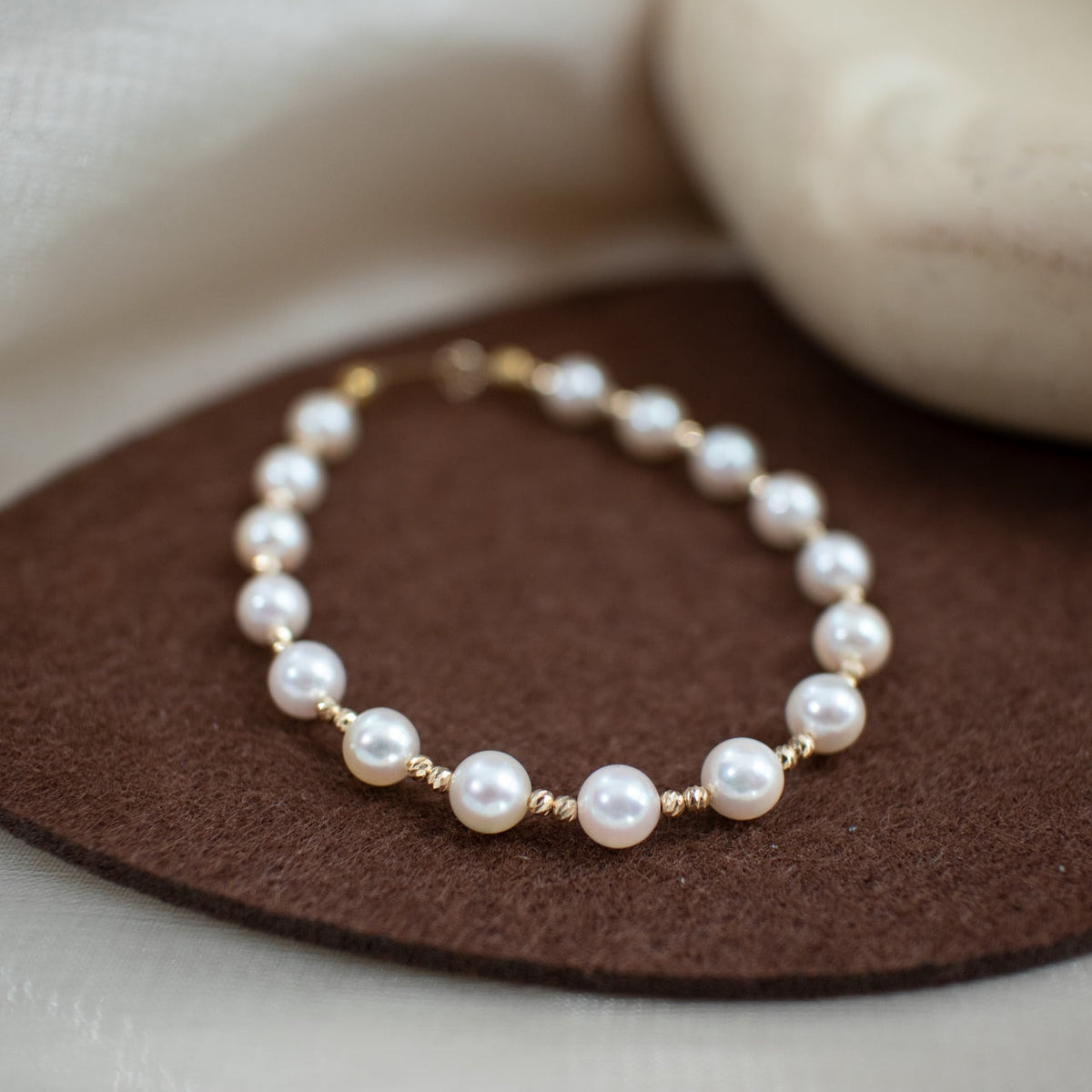
The size and shape of the beads in the pearl bracelet symbolize...
Pearl Bracelet Bead Size Guide: What Each Millimeter Actually Means
Pearl size is not just a number on a spec sheet. It changes how the bracelet sits on your wrist, what it says about you without saying a word, and which occasions it belongs on. A 4mm bead whispers. A 10mm bead announces. Everything in between carries its own quiet authority. Knowing what each size tier means — in style, in symbolism, in real-world wear — saves you from buying something that looks great in the shop but feels wrong the moment you put it on.
How Pearl Diameter Shapes the Entire Look
Baby Pearls: 3mm to 4mm
These are the "Baby pearls" — tiny, almost seed-like, with a delicate glow that catches light in a scattered, almost dewy way. They scream youth. If you are under 30 and want your wrist to look fresh and effortless, this is the range. Single-strand they can feel underwhelming, but stacked two or three high, or mixed with gold chains, they build a layered look that feels intentional without trying too hard.
Culturally, smaller pearls lean toward meanings of peace and safety. They are not about power or presence — they are about understated grace. Pair them with 7mm to 8mm strands for contrast, and the size gap creates visual rhythm that makes both sizes pop.
The Sweet Spot: 5mm to 7mm
This is where most people land, and for good reason. A 5mm to 6mm pearl bracelet is the office workhorse — visible enough to notice, quiet enough not to distract. It fits a standard wrist (14cm to 16cm circumference) without crowding. A 6mm to 7mm step up adds just enough weight to feel substantial. You can type, you can drive, you can grab coffee — nothing gets in the way.
At this size, the pearl starts carrying a dual message. It is still approachable, but it also signals that you pay attention to detail. For women aged 30 to 50 who want elegance without effort, this range hits the bullseye every time.
Statement Territory: 8mm and Above
Cross 8mm and the bracelet stops being an accessory and starts being a declaration. An 8mm to 9mm pearl is where casual meets luxurious — you can wear it to brunch and it still looks expensive. Push past 10mm and you are in rare, collector-grade territory. These pearls are grown longer inside the oyster, which means fewer of them exist, and each one carries the weight of that scarcity.
Large pearls have always symbolized wealth and authority. In traditional Chinese culture, the more pearls you string together, the more fortune you invite — because the word for "many" sounds like the word for "abundant blessings." A strand of oversized pearls is not just jewelry. It is a wearable wish for prosperity.
For wrists over 16cm circumference, anything under 8mm will look lost. Go big or go home.
What the Numbers Mean Beyond Millimeters
Bead Count and Its Hidden Language
Size gets all the attention, but the number of beads on your bracelet carries its own symbolic weight — and it interacts with size in ways most people never think about.
A single bead — called the "lucky transfer bead" — means smooth sailing, one wish, one focus. Three beads represent body, speech, and mind working in harmony. Six beads? That is the classic "everything goes smoothly" blessing. Eight beads pull in the "wealth from all directions" energy. Ten beads mean perfection — nothing missing, nothing extra.
Twelve beads tie to the twelve links of dependent origination, a Buddhist concept about cause and effect. Eighteen beads — known as the "eighteen sons" — is the most popular count for a reason. It represents eighteen levels of protection, and it fits almost every wrist comfortably. Twenty-one beads mark the twenty-one stages of enlightenment, a favorite for anyone chasing a promotion or a big project.
Why Odd Counts Often Win
Here is a pattern worth noticing: odd-numbered strands (1, 3, 5, 7, 9, 21, 27, 108) tend to be considered more auspicious in traditional belief systems. Odd numbers are "yang" — active, balanced, forward-moving. A strand of 108 beads, the most iconic count in Buddhist practice, is said to eliminate all 108 worldly troubles. Wrapped three or four times around the wrist, it becomes a meditation tool as much as a bracelet.
That said, even counts dominate the market for purely practical reasons — symmetry looks clean, and beads divide evenly. An 18-bead or 16-bead strand sits perfectly balanced on the wrist. Do not let tradition override comfort. If an even number feels right on your arm, wear it.
Matching Size to Your Wrist, Your Age, Your Life
By Wrist Circumference
A wrist under 14cm is slender. Stay in the 2mm to 6mm range. Anything larger will overwhelm the frame and slide around. A standard 14cm to 16cm wrist handles 5mm to 8mm without issue — this is the widest compatible range, which is why it dominates the market. Wrists over 16cm need 8mm or bigger. Small pearls on a wide wrist look like they are floating, not sitting.
By Age and Style
Women in their 20s tend to gravitate toward 2mm to 6mm — playful, trendy, stackable. Women in their 30s to 50s find their home in 6mm to 9mm — polished, credible, age-appropriate without being aging. Women over 50 often look stunning in 8mm to 12mm pearls, especially gold-toned South Sea varieties, because large pearls match the confidence that comes with decades of living.
For men, the sizing jumps up. A 165cm to 170cm frame suits 13mm to 15mm beads. Taller men (180cm to 190cm) should go 16mm to 18mm. A single large bead on a man's wrist reads as intentional, not decorative — and that is exactly the point.
By Occasion
Daily office wear: 4mm to 6mm, single strand, nothing that clacks against your keyboard. Casual weekend: multi-strand baby pearls or a relaxed 6mm to 7mm single. Formal event: 8mm or above, high luster, minimal strand count so each bead has room to breathe. Important milestone — a wedding, an anniversary, a promotion: 10mm plus, and consider 108 beads wrapped tight for that sense of gravity and intention.
The Luster Factor That Overrides Size
Diameter matters, but luster matters more. A 6mm pearl with mirror-sharp reflection — one where you can see your own face in the surface — will always outperform a dull 9mm pearl. When shopping, tilt the bead under light. If the reflection is crisp and the glow seems to come from deep inside the nacre, the size is just a bonus. If the surface looks chalky or flat, no millimeter count will save it.
Roundness plays the same role. Perfectly round pearls cost more and look better, but slightly off-round or baroque shapes have their own charm — especially in design-forward pieces where irregularity is the point. Just know that traditional symbolism leans toward round: completeness, wholeness, nothing missing.